Small Business Legal Defense in the Age of AI
The notification lands like an unexpected blow. An email appears with a subject line that makes your stomach turn: "LEGAL NOTICE: Demand for Payment" or "URGENT: Cease and Desist." Your focus instantly changes from business planning and growth strategies to one terrifying number. A request for payment of $50,000, $100,000, or even more for a supposed copyright breach or a previously overlooked liability. Your first impulse is to contact an attorney, but this instinct is followed by a second wave of anxiety when you learn about the retainer fee: $10,000, $15,000, or even $25,000 just to begin. Many entrepreneurs face this devastating choice-an option between a potentially business-ending settlement and a financially crippling legal battle.
But imagine there's a different approach? What if you could fight back intelligently, strategically, and affordably? For more and more entrepreneurs, this alternative approach is now possible through AI legal defense. This isn't about replacing lawyers entirely, but about shifting the traditional approach. It's about leveraging advanced AI to evaluate challenges, create defenses, and comprehend your legal standing before investing in expensive legal services. This shows how entrepreneurs are fighting back on legal bullies, cutting down on substantial legal costs, and discovering the strength to defend their businesses in today's litigation-prone business landscape.
Vital Key Points
- A Shift in Power Balance: Artificial intelligence is enabling business owners to address common legal issues independently, decreasing reliance on expensive legal counsel for preliminary legal responses.
- Education is Your Best Defense: Most legal threats targeting small businesses are designed to intimidate and typically rest on weak legal foundations. Understanding the fundamentals of copyright law and debt validation can be your most powerful weapon.
- AI as a Research Assistant: Artificial intelligence can analyze legal documents, identify weaknesses in claims, and find applicable legal precedents in much faster than traditional methods, reducing your legal costs substantially.
- Pricing is a Critical Element: Considering typical legal retainers that begin at $10,000-$25,000, artificial intelligence-based solutions offer a budget-friendly preliminary protection option at a significantly lower price point.
- Know When to Contact a Professional: AI is a valuable resource for preliminary work and first steps, but it is not meant to be a substitute for a qualified lawyer in cases involving complex legal situations or ongoing court cases.
Navigating the Legal Landscape for Small Business Owners
Running a small business is managing numerous responsibilities. You find yourself acting as the executive, marketing specialist, personnel manager, and sometimes even the custodian. The last thing you can afford is legal trouble while running your operations. However, contemporary business operations face numerous legal challenges. Recent data from 2023 indicates that small businesses in the United States lose an annual $160 billion in lawsuit-related expenses. These aren't just major lawsuits making headlines; it's the regular legal issues that gradually drain businesses.
The Rise of the Litigation Bully
Many legal threats aren't focused on justice; they are fundamentally a numbers game. Predatory firms, copyright trolls, and aggressive collectors distribute massive amounts of threatening correspondence, knowing that some of people who receive them will be too scared or too uninformed to stand up for their rights. They rely on the fact that attorney fees typically exceed than the payment they're seeking. This generates a problematic motivation to give in, regardless of whether the case is valid. These organizations serve as legal bullies, using intimidation as their primary tactic.
Major Challenges for Business Owners
Even though legal challenges may emerge from various sources, several typical problems frequently impact small enterprises:
- Copyright Infringement Claims: These claims are typically associated with images utilized on company websites or blogs. Many of these claims are automated and distributed without actual human oversight of context or fair use considerations.
- Debt Collection Notices: Collectors often send notices regarding expired, disputed, or even invalid debts. Collection companies commonly acquire debts for minimal costs and utilize intimidating strategies to demand complete payment.
- Cease and Desist Letters: These legal documents can cover various types of legal issues, including intellectual property conflicts and contractual breaches. They are frequently utilized to deter competition or silence opposition.
- Banking and Payment Disputes: Conflicts with payment processors or banks can suspend financial access and operations, forcing business owners to take defensive measures.
When business owners are confronted with these challenges, it often seems like a major crisis. However, the truth is that a majority of these issues are essentially matters of education and preparedness, instead of matters requiring litigation.
Small Business Legal Defense: The Hidden Costs of Traditional Approaches
The conventional method for handling a legal threat is simple: you hire a lawyer. For big companies with in-house legal teams and substantial resources, this is a routine cost of running a company. For a small company, it's a significant financial strain. The typical legal expenses for a small company is about $13,300 per year, but this number can rise significantly when litigation is involved, with costs ranging from $3,000 to over $150,000.
Breaking Down the Retainer Model
The most significant immediate obstacle is the attorney retainer. A retainer is essentially an upfront payment on a lawyer's services, and when it comes to litigation, it's almost never under five figures. This creates what is often called the "retainer trap." A business owner might receive a claim for $8,000. A lawyer quotes a $15,000 retainer to contest the claim. From a financial perspective, the seemingly logical decision seems to be settling for the $8,000 payment, even if the allegations are unfounded. This is the approach that predatory litigants rely on. They've deliberately priced their claims to be just below the threshold cost to fight back legally.
Divergent Interests
Additionally, the traditional legal model is structured on billable hours. Lawyers get paid more when cases take longer. While ethical lawyers aim for efficiency, the framework naturally incentivizes prolonged cases and complicated proceedings. This presents a direct conflict with the needs of small business owners, who need solutions that are quick, efficient, and cost-effective. The key priority for the business owner is to address the situation, not to get caught up in a time-consuming and expensive legal procedure.
How AI is Revolutionizing Legal Support for Business Executives
Throughout recent history, the steep pricing of legal assistance created a massive gap in the market. No feasible alternative was available for business owners who were unable to finance legal counsel but refused to give in to unfounded allegations. Artificial intelligence is presently closing that gap. It's not a magic wand, but it is a powerful tool that levels the playing field by significantly decreasing the cost and time connected to the essential early steps of defending against legal claims.
AI: Transforming Paralegal Work
Consider AI similar to a paralegal equipped with a photographic memory and the ability to analyze enormous volumes of documents every minute. Let's explore its applications:
- Document Analysis: Artificial intelligence tools can thoroughly review a demand letter or legal complaint and rapidly detect key information, like specific allegations, legal statutes referenced, and demanded compensation amounts. The system matches the content with vast legal records to discover trends and possible flaws.
- Legal Research: Rather than legal counsel investing considerable time (at $300+ per hour) investigating legal precedents, AI technology can search legal databases and deliver applicable case law in seconds. It can find information on debt validation requirements, fair use provisions, or specific consumer protection statutes that apply to the matter.
- Drafting Assistance: AI is capable of drafting initial response letters. When given the claim details and pertinent legal guidelines, it can create a professional, organized document that establishes your position and signals to the other party that you will defend your position firmly.
This is where the game changes. The first evaluation and examination, which typically runs thousands in legal fees, can now be accomplished with a much smaller investment in an artificial intelligence learning solution.
The AI Legal Defense Framework: Your Comprehensive Guide
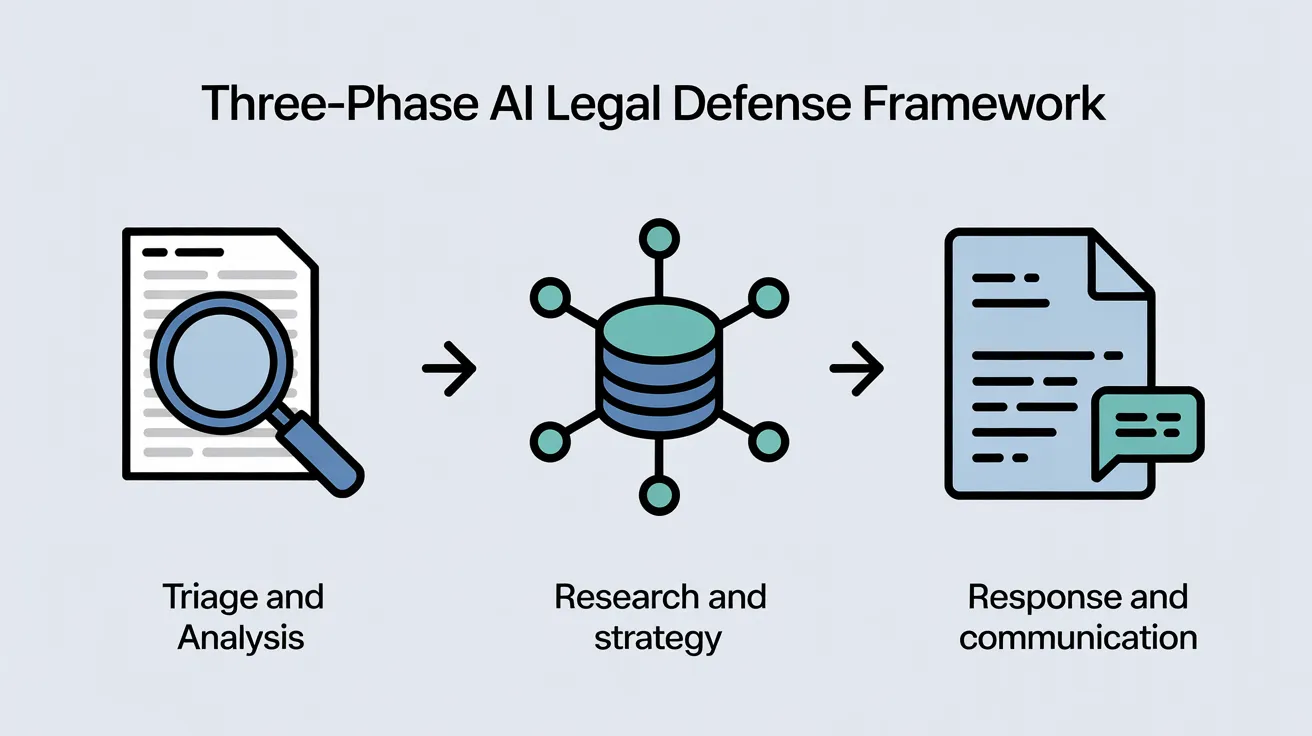
Implementing AI for legal defense isn't simply blindly relying on a chatbot. It involves adhering to a methodical process to analyze the situation, comprehend your standing, and react from a foundation of strength. This framework typically encompasses three key phases.
Phase 1: Triage and Evaluation
To begin is to leverage artificial intelligence to comprehend the situation at hand. You can feed the legal threat or demand letter into an AI system and have it conduct an preliminary review. The goal is to answer several critical questions:
- What is the core allegation
- Which specific statutes or laws are being cited?
- Is the claiming party the verified rights holder?
- What documentation have they shown?
- Are there any concerning indicators in the claim details?
This initial assessment allows you to move from a state of panic to having clear understanding. It gives a straightforward, neutral assessment of the circumstances.
Stage 2: Research and Planning
After analyzing the claim, the following stage is to utilize AI to research your defensive possibilities. For a copyright claim, you can prompt the AI to examine the four factors of fair use and how they apply to your unique situation. For a debt collection notice, you would instruct it to outline the validation requirements under the Fair Debt Collection Practices Act (FDCPA). This step is centered on developing your case. You are accumulating the legal principles and facts that will establish the foundation of your response. This is also where you can commence to spot the vulnerabilities in your adversary's position.
Phase 3: Response and Communication
Now that your research is complete, you can leverage AI to help craft your letter. This isn't meant for sending a computer-generated response. Rather, it focuses on employing AI to assist your writing. You input the key arguments and factual background, and AI assists in crafting this information into a well-structured and polished response. Your response should typically:
- Verify receipt of what they sent.
- Present your stance with clarity and brevity.
- Mention the relevant legal concepts that back up your argument.
- Request extra documentation or verification, as necessary.
- Keep the content factual and emotion-free.
This structured response demonstrates to the opposing side that you are well-prepared, knowledgeable, and organized to maintain your position. It promptly shifts the situation from one of pressure to one of a serious legal conversation.
Handling Copyright Claims: AI Analysis and Response Solutions
Copyright claims stand as a significant risk for online businesses. A company might use a photograph on their blog, only to receive a substantial monetary claim from a photo licensing agency down the line. Artificial intelligence proves especially useful when handling these matters.
Evaluating the Claim
An AI tool can aid in website evaluating the claim. It examines the claim letter to verify if it includes evidence of copyright ownership, an official registration number, and a clear explanation of the supposed copyright breach. A lot of claim letters from predatory copyright claimants are deliberately ambiguous and don't include this vital documentation. As entrepreneur Tony copyright of LinkDaddy found out, AI can be used to assess the legitimacy of a demand, enabling an effective defense against a $500,000 copyright lawsuit without engaging a lawyer.
Exploring Fair Use Concepts
AI can be a powerful tool for researching the doctrine of fair use. Fair use represents a legal doctrine that permits controlled utilization of copyrighted material without authorization from the rights holder. An AI can help you understand the four factors of fair use and how they might apply to your case, offering you with the reasoning you need to construct a strong defense.
Validating Debt Collections: AI-Enhanced Defense Strategies
Another area where AI is showing remarkable results is in safeguarding against forceful debt collection practices. The Fair Debt Collection Practices Act gives individuals and entrepreneurs certain protections, like the option to obtain proof of debt.
The Power and Impact of a Letter of Validation
A collection agency must supply you with details about the debt, called validation documentation. When you send a debt validation letter, you are officially asking that the collector prove that you owe the debt and that they have the legal right to collect it. A lot of debt collectors, especially those who purchase old debt, cannot provide this information. An AI can assist you with creating a complete debt validation letter that asks for all the essential documentation, such as:
- The name of the initial creditor
- Your previous account number
- A copy of the original signed contract.
- A detailed account of the reported debt.
Delivering a proper validation letter usually prevents a debt collector in their tracks. If they cannot validate the debt, they are legally prohibited from proceed with collection efforts.
Understanding AI Legal Defense: When It Works and When It Doesn't
It is crucial to comprehend the boundaries of AI in the legal industry. AI serves as a learning and preparation resource, not a certified legal practitioner. Understanding the boundary between what you can address personally and when you require legal assistance is the key to a successful defense strategy.
Optimal Cases for AI Defense Implementation
- Initial Threat Assessment: Evaluating demand letters and cease and desist notices.
- Responding to Baseless Claims: Crafting professional replies to copyright trolls and debt collectors who use intimidation methods.
- Legal Research: Understanding your rights and the laws applicable to your case.
- Organizing Your Case: Preparing all your materials and arguments before approaching a lawyer, which could save thousands in legal fees.
When to Contact a Lawyer Right Away
There are certain situations where you should avoid a DIY legal defense. If you've been served an actual lawsuit, you should seek legal representation. Other scenarios demanding a lawyer's immediate attention encompass:
- Criminal charges.
- Government agency regulatory investigations.
- Complex legal matters involving different parties across multiple jurisdictions.
- Major circumstances where the possible losses could destroy your enterprise.
In such cases, the role of AI transforms from a core defense tool to a support system. You can utilize it to become more knowledgeable and prepared as a client, but you must have a professional specialist on your side.
Creating Your AI Legal Defense Arsenal
Beginning AI legal defense doesn't need a degree in computer science. It primarily requires a commitment to learn and availability of the proper tools. The core of your toolkit will be a powerful language model like ChatGPT or Claude, alongside an educational platform that delivers specific prompts and frameworks for standard legal threats.
The Critical Role of Professional AI Instructions
The effectiveness of any AI solution is determined by how well you craft your prompts. A generic prompt like "write a response to this demand letter" will result in a basic and potentially inadequate result. Conversely, a targeted prompt will direct the AI to perform a thorough analysis and produce a response grounded in particular legal concepts. This explains why platforms that provide battle-tested prompts and frameworks are so beneficial.
Small Business Success Stories: Standing Strong
The inspiring case of Tony copyright, who successfully saved his business in excess of $511,000 by using AI to combat three major legal threats, serves as a powerful example of what can be accomplished. But he isn't standing alone. Across the country, small business owners are discovering that they possess more power than they believed. They are leveraging AI to challenge baseless copyright claims and require debt collectors to validate their debts. These achievements are not merely about reducing costs; they symbolize reclaiming a sense of control and choosing not to be victims of a system that has traditionally been weighted against them.
Emerging Trends in Small Business Legal Defense
The integration of AI within the legal field is still in its early stages, but the pattern is clear. The delivery of legal services is growing more attainable and cost-effective. The conventional guardians of the legal profession are being challenged by digital tools that assist private citizens and companies. This isn't to say that lawyers will become obsolete. It means that their role will evolve. They will be able to dedicate themselves to the advanced, intricate matters that actually demands their expertise, while technology handles the more routine and preparatory tasks.
Small business proprietors, this represents a welcome change. This suggests that moving forward, a legal challenge may no longer be a moment of financial panic, but rather an issue to be addressed systematically and intelligently.
Making Your First Move: Your First Steps with AI Legal Defense
As a small business owner, you need to begin exploring AI legal defense is now, before you need it. Familiarize yourself with existing resources and solutions. Master the essential aspects of legal protection and financial recovery. Through these preventive measures, you can establish strong defenses for your company. You can evolve from being a vulnerable business into a knowledgeable guardian of your company's accomplishments.
FAQs
Can AI actually help with legal defense, or is it simply exaggerated claims?
AI functions as an essential instrument for legal defense, but it's vital to understand its role. It is not a replacement for a lawyer. Instead, think of it as a highly effective support tool for research and preparation. It can help you analyze documents, understand complex legal topics, and prepare preliminary responses, all of which can save you a significant amount of time and money. The important thing is to employ it for preliminary defense preparation and to understand when to consult an experienced attorney.
How do I choose between AI tools and legal counsel?
Leverage AI tools to perform the first analysis of legal challenges, when crafting responses to what appear to be meritless claims (like those submitted by copyright trolls), and for organizing your legal case. You should engage a lawyer without delay if you receive with a lawsuit, deal with criminal charges, or are dealing with a complex legal situation that could significantly impact your business. A reliable guideline is: leverage AI for groundwork, but rely on a lawyer for litigation.
How much money can I save by using AI in my legal defense?
The cost savings can be substantial. The initial legal review and demand letter response can cost thousands in lawyer fees. Using an AI-powered platform can reduce this to a fraction of the cost. Successfully addressing threats during this initial phase can save you tens of thousands. Should you require an attorney later, prior AI assistance can help decrease their billable hours.
What are the key limitations of AI in legal contexts?
There are multiple key limitations to AI. It doesn't have legal status and can't represent anyone in court. It lacks the refined decision-making abilities of an experienced attorney and might not comprehend the intricacies of individual legal situations. Moreover, it operates using its training dataset, which could be outdated. Above all, an AI system cannot provide legal advice, only information and support.
Is it legal leveraging AI to perform analyzing legal documents?
Using AI to analyze and understand documents is completely legal. You are just utilizing a technological aid for research and preparation, much like using a search engine or word processor. The critical legal boundary is that you cannot claim to be a legal professional without proper credentials, and artificial intelligence cannot function as your legal representative.
6. How do I determine if a legal threat is real or just intimidation?
Here's where AI analysis can be particularly useful. A genuine legal notice typically will generally be specific, provide proof of the allegations (including a copyright registration number), and originate from a recognized law firm. An intimidation tactic, however, is often unclear, is missing evidence, and often features threatening or unsuitable language meant to force a hasty payment. AI can help you spot these red flags.
How does the Fair Debt Collection Practices Act (FDCPA) safeguard my rights?
The FDCPA is a federal law that regulates the behavior of third-party debt collectors. It protects you from unfair, deceptive, or abusive practices. One of its most powerful provisions is your ability to demand proof of the debt. If collectors are unable to verify the debt's validity and their legal right to collect, they are required to cease collection activities. This is a crucial protection for entrepreneurs who could be pursued for invalid or aged debts.